
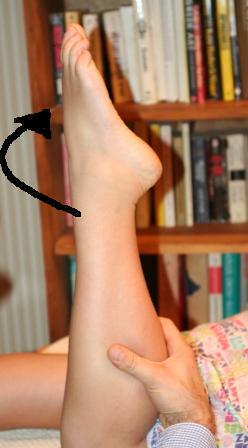
Name of testThompson test What it testsIntegrity of Achilles tendon. How to do itThe patient lays prone on the examining table. The affected leg is flexed 90, perpendicular to the table (blue lines). The examiner firmly squeezes the gastrocnemius (black arrows). The examiner examines the ankle for plantar flexion. The normal responseWhen the examiner firmly squeezes the gastrocnemius, plantar flexion of the ankle is seen (second figure). What it means if not normalA ruptured Achilles tendon. CommentsActive plantar flexion may be present in a patient with a ruptured Achilles tendon via the combined actions of the tibialis posterior, flexor digitorum longus, and flexor hallucis longus muscles. If a patient has weak plantar flexion and you suspect an Achilles rupture, the Thompson test may be useful to assess the integrity of the tendon. A positive Thompson test has been reported to not necessarily indicate a complete rupture of the tendon, and has been seen in cases where only the gastrocnemius portion of the tendon was disrupted, with the soleus portion intact. (see reference below) Citations13920945, 19503640 Unknown macro: {cite} | Figures
|
Attachments:


Last Updated on September 27, 2026
🔗 Knowledge Graph & Clinical Correlates
OrthopaedicsOne Living Semantic Network🛠️ Operative Techniques
- Wound coverage techniques Foot and Ankle
- V-Y Advancement and FHL Transfer for the Chronic or Neglected Achilles Tendon Rupture – Raikin Foot and Ankle
- V-Y Advancement and FHL Transfer for the Chronic or Neglected Achilles Tendon Rupture – Panchbhavi Foot and Ankle
- Treatment of syndesmosis disruptions Foot and Ankle
🧭 Surgical Approaches & Danger Zones
- Transfibular Approach Ankle Arthrodesis Ankle Joint & Pilon
🔬 Anatomy, Pathology & Diagnostics
- Watson test Wrist and Carpus
- Varus stress test of the knee Knee Joint & Extensor Mechanism
- Valgus stress test of the knee Knee Joint & Extensor Mechanism
- Ulnar nerve motor Forearm (Radius & Ulna)