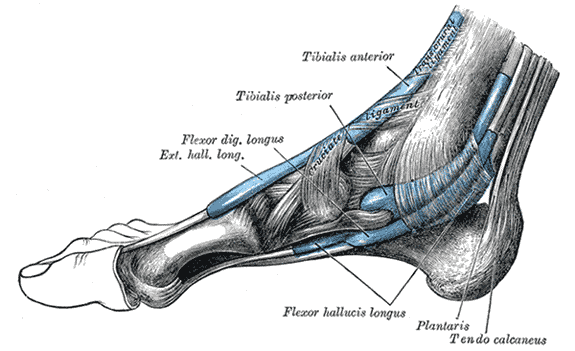
Origin | Lateral supracondylar ridge of femur above lateral head of gastrocnemius |
|---|
Insertion | Tendo calcaneus (medial side, deep to gastrocnemius tendon) |
|---|
Action(s) | Plantar flexes foot and flexes knee |
|---|
Nerve Supply | Tibial nerve |
|---|
Arterial Supply | Sural arteries |
|---|
Physical Exam | Enter physical examination maneuvers for muscle |
|---|
Clinical Importance | Enter clinical importance of muscle |
|---|
Disease States | Enter links to pages where muscle involved |
|---|
Discussion | Functions: Plantaris acts to weakly: -Plantarflex the ankle joint
-Flex the knee joint Plantaris may also provide proprioceptive feedback information to the central nervous system regarding the position of the foot. The unusually high density of proprioceptive receptor end organs supports this notion. Its motor function is so minimal that its long tendon can readily be harvested for reconstruction elsewhere with little functional deficit. Often mistaken for a nerve by freshman medical students (the so called, “freshman nerve”), the muscle was useful to other primates for grasping with their feet. It has disappeared altogether in 9 percent of the population. |
|---|
| FiguresClick thumbnail for larger image Credits: From Wikipedia:
Plantaris |
Attachments:
Last Updated on June 27, 2024
🩺 Clinical Conditions & Indications
🔬 Anatomy, Pathology & Diagnostics
💼 Practice Management & Professional Operations
🕸️ Semantic Relations (RDF)