• O1 Network
    • Articles
    • For Residents
    • For Medical Students
    • PORT Notes
    • MSK Medicine
    • Tumor Library
    • Cases
    • Talks
    • Images
    • Viewpoints
    • Question Bank
    • Devices
    • Residency
    • Fellowships
    • Associations
    • Companies
ORTHOPAEDICSONE ARTICLES
OrthopaedicsOne Articles
  • Articles
    • Specialty
      • Arthroscopy
      • Foot and Ankle
      • Hand and Wrist
      • Hip and Knee
      • Infection
      • Joint Reconstruction
      • Musculoskeletal Medicine
      • Pediatrics
      • Shoulder and Elbow
      • Spine
      • Sports Medicine
      • Trauma
      • Tumor
    • Regional
      • Anatomy
      • Basic Science
      • Classifications
      • Diagnostic Tests
      • Evidence-Based Orthopaedics
      • Operative Techniques
      • Pain Management
      • Physical Examination
      • Pharmacology
      • Radiology
      • Rehabilitation
      • Rheumatology
      • Surgical Approaches
    • Professional
      • Bioethics
      • Economics and Health Policy
      • Epidemiology and Biostatistics
      • History of Orthopaedics
      • Informatics
      • Medicolegal
      • Mobile and Wireless
      • Practice Management
  • Reviews
    • For Residents
    • For Medical Students
  • eBooks
    • PORT Notes
    • MSK Medicine
    • Tumor Library
  • Community
    • Cases
    • Talks
    • Images
    • Viewpoints
    • Question Bank
    • Devices
  • Pages
    • Residency
    • Fellowships
    • Associations
    • Companies
  • About O1
    • Overview
    • FAQs
    • Managing Editors
    • Editorial Board
    • Content Partners
    • Participating Groups
    • Advisory Board
    • Sponsoring Organizations
    • Contact Us
  • Click to open the search input field Click to open the search input field Search
  • Menu Menu

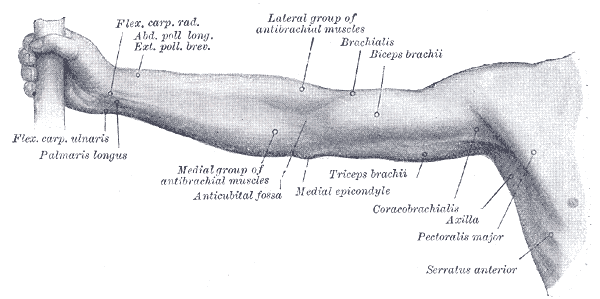
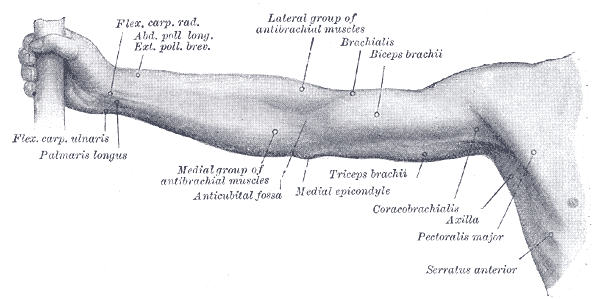
Palmaris longus

Origin

Medial epicondyle of humerus (common flexor tendon)

Insertion

Palmar aponeurosis

Action(s)

Wrist flexor

Nerve Supply

Median nerve

Arterial Supply

Ulnar artery

Physical Exam

Enter physical examination maneuvers for muscle

Clinical Importance

REVERSED PALMARIS LONGUS

  • first reported by Captain John T. Morrison in 1916 as an incidental, post-amputation finding
  • variations in Palmaris Longus anatomy are thought to be asymptomatic; however, several authors have described variations of the reversed Palmaris, many of which may cause symptomatic median nerve compression (carpal tunnel-like compression)

Disease States

Enter links to pages where muscle involved

Discussion

The palmaris longus is a variable muscle, absent in about 16 percent of Caucasians, and less frequently absent in other populations. It may be tendinous above and muscular below; or it may be muscular in the center with a tendon above and below; or it may present two muscular bundles with a central tendon; or finally it may consist solely of a tendinous band.

The muscle may be double.

Slips of origin from the coronoid process or from the radius have been seen.

Partial or complete insertion into the fascia of the forearm, into the tendon of the Flexor carpi ulnaris and pisiform bone, into the scaphoid, and into the muscles of the little finger have been observed.

The Palmaris Longus is one of the most variable muscles and this should consider in surgery of the wrist where good orientation is essential
Recognizing the possibility of atypical variants of Palmaris Longus can be challenging preoperatively
Unless there is very high suspicion of mass effect, most surgeons would not consider imaging studies as part of their diagnostic workup of carpal tunnel syndrome

Figures

Click thumbnail for larger image

Credits:

From Wikipedia:
Palmaris longus

Attachments:


Palmaris longus.png (image/png)


Palmaris longus.png (image/png)

Last Updated on June 27, 2024

🔗 Knowledge Graph & Clinical Correlates

OrthopaedicsOne Living Semantic Network

🛠️ Operative Techniques

  • Volar Plate Arthroplasty Hand and Wrist
  • Volar Ligament Stabilization of the Unstable Thumb CMC Joint Hand and Wrist
  • Traumatic amputations of the fingertip Hand and Wrist

🩺 Clinical Conditions & Indications

  • Volar plate injury 1. High-Yield Summary Volar plate injuries of the proximal interphalangeal (PIP) joint represent the most frequent soft-tissue and...
  • VATER syndrome 1. High-Yield Summary Condition Definition: VATER association is an acronymic constellation representing a non-random cluster of congenital malformations:...
  • Vascular malformations of the hand 1. High-Yield Summary Biological Classification: Vascular malformations are congenital non-neoplastic developmental anomalies of vascular embryogenesis with stable endothelial...
  • Ulnar collateral ligament sprain of the thumb 1. High-Yield Summary Ulnar collateral ligament (UCL) injury of the thumb metacarpophalangeal (MCP) joint is a common and...

🔬 Anatomy, Pathology & Diagnostics

  • Wrist joint Wrist and Carpus
  • Vertebra prominens Surface Anatomy Lumbar Spine
  • Vastus medialis Femoral Shaft
  • Vastus lateralis Femoral Shaft

🕸️ Semantic Relations (RDF)

ABOUT

  • Overview
  • FAQs
  • Managing Editors
  • Editorial Board
  • Content Partners
  • Participating Groups
  • Advisory Board
  • Sponsoring Organizations
  • Contact Us

ARTICLES

  • Arthroscopy
  • Foot and Ankle
  • Hand and Wrist
  • Hip and Knee
  • Infection
  • Joint Reconstruction
  • Musculoskeletal Medicine
  • Pediatrics
  • Shoulder and Elbow
  • Spine
  • Sports Medicine
  • Trauma
  • Tumor

REVIEWS

  • For Residents
  • For Medical Students

EBOOKS

  • PORT Notes
  • MSK Medicine
  • Tumor Library

COMMUNITY

  • Talks
  • Images
  • Viewpoints
  • Question Bank
  • Devices

PAGES

  • Residency
  • Fellowships
  • Associations
  • Companies
Copyright © 2012-2026 OrthopaedicsOne | Privacy Policy | Dr. Christian Veillette . Powered by: OrthoNet - Empowering the Future of Orthopaedic Care
Scroll to top Scroll to top Scroll to top