
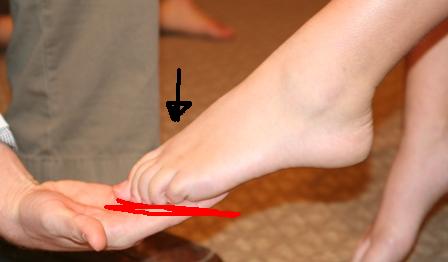
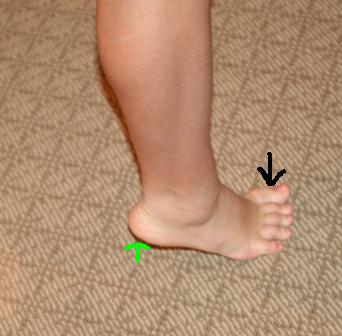
Name of testAnkle plantar flexion What it testsFunction of gastroc-soleus complex How to do itHave patient actively plantar flex the ankle (black arrow) against resistance (red line) The normal responseStrong plantar flexion. Note that active plantar flexion against manual resistance can seem strong to the examiner’s hand even with true weakness (relative to normal demands). That’s because the legs are typically so much stronger than the arms. Also, a reasonable amount of plantar flexion strength may be seen even with a complete Achilles rupture as the posterior tibialis and toe flexors powers plantar flexion motion too. What it means if not normalTrue weakness could reflect primary muscle weakness, tendon rupture or nerve pathology (sciatic in general, tibial nerve specifically, or nerve roots S1 or S2) Achilles tendon pathology causing pain may lead to guarding and apparent weakness. CommentsBest done as a series of toe-rises (stepping down on the forefoot to elevate the heel, shown in the second figure), as subtle weakness will not be apparent on manual testing. A normal patient should be able to elevate off the ground (green arrow) ten times consecutively without fatigue. A lack of tenderness to palpation along the Achilles should exclude tendinopathy. CitationsUnknown macro: {cite} | Figures
|
Attachments:

Last Updated on June 27, 2024
🔗 Knowledge Graph & Clinical Correlates
OrthopaedicsOne Living Semantic Network🛠️ Operative Techniques
- Wound coverage techniques Foot and Ankle
- V-Y Advancement and FHL Transfer for the Chronic or Neglected Achilles Tendon Rupture – Raikin Foot and Ankle
- V-Y Advancement and FHL Transfer for the Chronic or Neglected Achilles Tendon Rupture – Panchbhavi Foot and Ankle
- Treatment of syndesmosis disruptions Foot and Ankle
🧭 Surgical Approaches & Danger Zones
- Transfibular Approach Ankle Arthrodesis Ankle Joint & Pilon
🔬 Anatomy, Pathology & Diagnostics
- Watson test Wrist and Carpus
- Varus stress test of the knee Knee Joint & Extensor Mechanism
- Valgus stress test of the knee Knee Joint & Extensor Mechanism
- Ulnar nerve motor Forearm (Radius & Ulna)