Single-Bundle ACL Reconstruction
My preference is to do an anatomic single-bundle anterior cruciate ligament (ACL) reconstruction for various reasons.
Even though there is support for the double-bundle concept from the standpoint of both anatomy and biomechanics, the published clinical evidence supporting double-bundle reconstruction is insufficient. Most of the randomized controlled trials comparing single- vs double-bundle ACL reconstruction show no subjective improvement and only a slight reduction in the incidence of a positive pivot shift with the double-bundle reconstruction.
 Read more…
Success of Single-Bundle Technique
Single-tunnel ACL reconstruction has been a successful procedure. In 2008, Lewis et al reviewed 11 clinical trials comparing single-bundle patellar tendon and hamstring grafts consisting of 1,024 reconstructions. The outcome measurements included a complication rate of 6%, a graft failure rate of 4%, negative pivot shift 81%, negative Lachman test 59%, and KT SSD less than 5 mm in 86%. After review of a considerable body of unbiased outcome data, Lewis et al concluded that single-bundle ACL reconstruction is a safe, consistent surgical procedure that affords reliable results. It is true that these are not optimum results, but I think the outcome can be improved more by anatomic tunnel single placement rather than switching to a double-bundle procedure.
If everyone were to switch to the double-bundle procedure, we would have more complications, increased cost of the procedure (twice as many implants), and surgeons frustrated with the very steep learning curve – all with only a very marginal improvement in outcomes. If outcomes were significantly better with double-bundle ACL reconstruction than with single-bundle reconstruction, then perhaps we could justify these issues.
Importance of Anatomic Placement
This is not really an argument for or against double-bundle reconstruction, but it is rather all about anatomic ACL reconstruction. Dr. Fu has brought to our attention the importance of anatomic placement of the tunnels. For the past 15 years, the most common technique in North America was to create the femoral tunnel through the tibial tunnel. This often resulted in a high anterior femoral tunnel.
When this was recognized, the tendency was to place the tibia tunnel more posterior on the tibia to reach the lower position on the femur. We were then creating a tibial PL to femoral AM position with the single tunnel. The position of the femoral tunnel was improved by drilling through the AM portal. This is not without its problems:
- Damage to the femoral condyle with the drill bit
- Cutting the anterior horn of the medial meniscus
- Incorrect placement of the femoral tunnel due to loss of orientation with hyperflexion
All these are overcome as the surgeon becomes more experienced with the technique. Identifying the anatomic site of the ACL, marking it, and confirming the position by viewing from the medial portal all help find this position with hyperflexion.
A new technique of drilling from the outside-in with the flipcutter is another method to place the femoral tunnel in the correct position without putting the knee into hyperflexion. In this situation, the guide is placed through the anterolateral portal and viewing is done via the medial portal. The anatomic position may be determined precisely when viewing from the medial portal. Avoiding the hyperflexion position makes it easier to convert from the tibial tunnel technique.
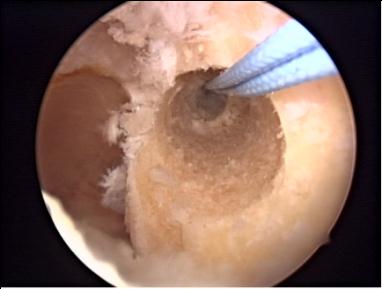
The position of the anatomic single tunnel should overlap both the AM and PL anatomic sites (Figure 1). The previous concept of going at the 11 o’clock position, and as far posterior as possible, is no longer considered ideal.
Figure 1. The femoral tunnel is low, and overlaps both the AM and PL anatomic sites.
Keep Technique as Easy as Possible
In my opinion, not everyone should be attempting a double-bundle ACL reconstruction. For the surgeon who occasionally performs ACL reconstruction, the technique should be kept as easy as possible. There probably is an indication for double-bundle ACL reconstruction, but right now I am not sure what it is. Should the patient with the gross pivot shift be considered? Or the one that has a touch of posterior lateral laxity?
The current method of evaluating rotational laxity is with the pivot shift test. This is a very subjective evaluation, yet it is the only outcome measurement that is used in these comparison studies. In my mind, that may introduce a significant bias. In one study comparing the single- versus double-bundle, the author quoted a 27% positive pivot shift in the single-bundle group. Either he is not placing the single-bundle in the correct position or there is an element of bias in the data.
In summary, anatomic single-tunnel ACL reconstruction is an easy, reproducible technique that has few complications and a minimal learning curve. The cost of converting to a new variant such as outside-in drilling is minimal.
Reprinted with permission from the Fall 2010 issue of COA Bulletin
Reference
- Lewis PB, Parameswaran AD, Rue JP, Bach BR Jr. Systematic review of single-bundle anterior cruciate ligament reconstruction outcomes: a baseline assessment for consideration of double-bundle techniques. Am J Sports Med 2008;36(10):2028-36.