Late Treatment of Knee Dislocations
The management of knee dislocations and knee dislocation patterns remains a challenging problem in orthopaedic surgery. Although this debate focuses on early or late treatment of knee dislocations, many variables come into play when a rational treatment algorithm is applied to the management of these complex injuries.
For example, we doubt that anyone would debate the need for urgent surgery on open or irreducible knee dislocations or in limbs with overt vascular injury or compartment syndrome. In these cases however, the urgent condition is addressed and the knee dislocation is often temporized with reduction and possible application of an external fixator. In addition, there is widespread agreement as to early treatment being preferred for acute bony ligament avulsions, particularly of the cruciate ligaments.
 Read more…
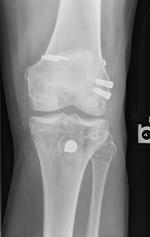
Figure 1a. AP radiograph of patient with reconstructed knee dislocation performed by tibial inlay allograft achilles PCL reconstruction, allograft hamstring ACL reconstruction and Laprade lateral collateral posterolateral corner achilles allograft reconstruction.
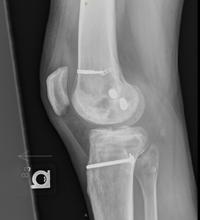
Figure 1b. Lateral radiograph of same patient.
Although the present treatment algorithm in place at our level 1 trauma centre is to treat knee dislocations early, this is not always possible. For example, many knee dislocations occur in the context high energy trauma, and as such occur concomitantly with a constellation of other injuries. In these cases, the definitive treatment of the unstable knee is often delayed until more life-threatening issues are dealt with, acute fractures have been definitively managed, local soft tissue has regained homeostasis and wounds have undergone appropriate orthoplastic reconstruction.
Therefore, it can occasionally take more than three weeks for the conditions to be met to go ahead with major knee ligament reconstruction. In addition, although we see the high energy injuries acutely, patients with low or ultralow energy knee dislocation patterns are often referred to our team only outside of the acute period for multiple reasons. Hence, perhaps more important than being in either the early or late camp of the debate, is understanding the potential outcomes of early vs. late treatment of knee dislocations.
There is a paucity of reliable evidence-based data available to guide our decision making with regards to surgical timing for the definitive treatment of knee dislocations. A review of the literature yields only a few retrospective cohort studies comparing the early and late management of knee dislocations.1-5 As a whole, these retrospective studies show a trend towards improved objective measurements, knee Lysholm and IKDC scores and higher sports activity scores on Knee Outcome Survey in the early treatment group. Early surgery has been implicated as a risk factor for arthrofibrosis.6-8 One of the studies comparing early and late management of knee dislocations had a higher incidence of postoperative arthrofibrosis in the early treatment group. However, statistically, there were no significant differences found in any of the studies comparing early and late management with regards final ROM or ADLs. All these studies were included in a recent excellent systematic review by Levy et al on the topic of the multiligament injured knee.
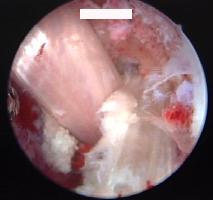
Figure 1c. Arthroscopic photograph of ACL and PCL reconstruction.
The definition most commonly employed in the literature for describing early and late in terms of surgical timing is three weeks for late treatment. This three-week cutoff is mildly arbitrary and perhaps becoming less definite with more modern operative techniques. In fact, historically, surgery within a three-week period from injury was recommended particularly for the associated posterolateral complex injuries, as it was felt to be the time period when the quality of tissues available for repair was optimal and dissection planes were still easily discernible.
However, just as surgical treatment of cruciate injuries has evolved toward reconstruction over repair in most cases, the same evolution may be happening in the treatment of posterolateral corner (PCL) injuries.10 Stannard et al recently reported in a level II prospective study that clinical stability was significantly better in cases of acute posterolateral complex reconstruction in comparison with traditional acute repair of the PLC.11 In addition, failures were significantly more common in the acute repair group. In fact, 37% of PLC repairs failed compared to 9% of reconstructed PLC. We have also favored reconstruction of the associated lateral and posterolateral injuries in our patients, and thus have put a lesser emphasis on the need to abide by the 21-day cutoff.
Although no trial has directly compared open vs. arthroscopic reconstruction, the trend has been toward arthroscopic management of the cruciate injuries. However, when these injuries are dealt with in an arthroscopically assisted manner, a few weeks should be allowed to pass for the associated capsular injuries to heal in order to decrease the risk of iatrogenic compartment syndrome from extracapsular accumulation of arthroscopic fluid. Therefore, arthroscopic management of knee dislocations may be more safely performed late.
In conclusion, although we agree with the results of the systematic review by Levy et al that early operative treatment of knee dislocations yields improved functional or clinical outcomes, if surgery is delayed longer than three weeks, the surgeon should not feel that excellent results are unattainable7. Surgical management of knee dislocations yields superior results to nonoperative management irrespective of surgical timing.1,12-14
Reprinted with permission from the Fall 2009 issue of the COA Bulletin
References
- Fanelli GC, Giannotti BF, Edson CJ, 1996. “Arthroscopically assisted combined posterior cruciate ligament/posterior lateral complex reconstruction.” Arthroscopy 12 (5): 521-30
- Harner CD, Waltrip RL, Bennett CH, Francis KA, Cole B, Irrgang JJ, 2004. “Surgical management of knee dislocations.” J Bone Joint Surg Am 86-A (2): 262-73
- Liow RY, McNicholas MJ, Keating JF, Nutton RW, 2003. “Ligament repair and reconstruction in traumatic dislocation of the knee.” J Bone Joint Surg Br 85 (6): 845-51
- Tzurbakis M, Diamantopoulos A, Xenakis T, Georgoulis A, 2006. “Surgical treatment of multiple knee ligament injuries in 44 patients: 2-8 years follow-up results.” Knee Surg Sports Traumatol Arthrosc 14 (8): 739-49
- Wascher DC, Becker JR, Dexter JG, Blevins FT, 1999 Mar-Apr. “Reconstruction of the anterior and posterior cruciate ligaments after knee dislocation. Results using fresh-frozen nonirradiated allografts.” Am J Sports Med 27 (2): 189-96
- Harner CD, Irrgang JJ, Paul J, Dearwater S, Fu FH, 1992 Sep-Oct. “Loss of motion after anterior cruciate ligament reconstruction.” Am J Sports Med 20 (5): 499-506
- Mohtadi NG, Webster-Bogaert S, Fowler PJ, 1991 Nov-Dec. “Limitation of motion following anterior cruciate ligament reconstruction. A case-control study.” Am J Sports Med 19 (6): 620-4; discussion 624-5
- Shelbourne KD, Wilckens JH, Mollabashy A, DeCarlo M, 1991 Jul-Aug. “Arthrofibrosis in acute anterior cruciate ligament reconstruction. The effect of timing of reconstruction and rehabilitation.” Am J Sports Med 19 (4): 332-6
- Levy BA, Dajani KA, Whelan DB, Stannard JP, Fanelli GC, Stuart MJ, Boyd JL, MacDonald PA, Marx RG, 2009. “Decision making in the multiligament-injured knee: an evidence-based systematic review.” Arthroscopy 25 (4): 430-8
- Mariani PP, Santoriello P, Iannone S, Condello V, Adriani E, 1999. “Comparison of surgical treatments for knee dislocation.” Am J Knee Surg 12 (4): 214-21
- Stannard JP, Brown SL, Farris RC, McGwin G, Volgas DA, 2005. “The posterolateral corner of the knee: repair versus reconstruction.” Am J Sports Med 33 (6): 881-8
- Fanelli GC, Edson CJ, 2002. “Arthroscopically assisted combined anterior and posterior cruciate ligament reconstruction in the multiple ligament injured knee: 2- to 10-year follow-up.” Arthroscopy 18 (7): 703-14
- Fanelli GC, Edson CJ, 2004. “Combined posterior cruciate ligament-posterolateral reconstructions with Achilles tendon allograft and biceps femoris tendon tenodesis: 2- to 10-year follow-up.” Arthroscopy 20 (4): 339-45
- Karataglis D, Bisbinas I, Green MA, Learmonth DJ, 2006. “Functional outcome following reconstruction in chronic multiple ligament deficient knees.” Knee Surg Sports Traumatol Arthrosc 14 (9): 843-7
Attachments:

Late_Tx_Figure_1a.jpg (image/jpeg)
Late_Tx_Figure_1b.jpg (image/jpeg)
Late_Tx_Figure_1c.jpg (image/jpeg)