Comparative Effectiveness of Kyphoplasty for Osteoporotic Insufficiency Fractures
It is estimated that age-related osteoporotic vertebral compression fractures (VCFs) occur in more than 500,000 patients per year in the United States. Failed nonsurgical management may lead to persistent pain and may require surgical intervention.
Minimally invasive methods of treating the symptoms of spinal compression fractures have generated considerable interest over the last two decades. Widely accepted treatment algorithms for the nonsurgical and surgical management of painful osteoporotic compression fractures have yet to be clearly established.2-4 The goal of this article is to examine the comparative effectiveness of kyphoplasty versus vertebroplasty and nonsurgical management of osteoporotic insufficiency fractures.
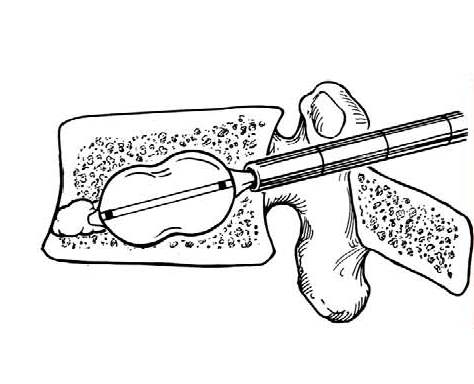
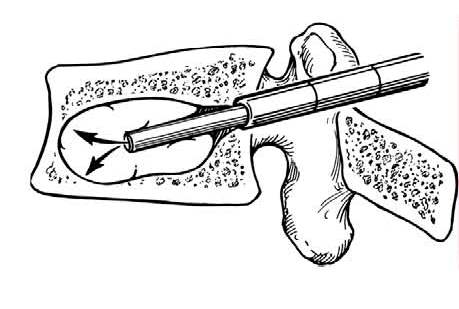
Vertebroplasty describes the percutaneous augmentation of a vertebral body by a hardening material and was originally used to manage painful neoplastic lesions. Kyphoplasty refers to the procedure of filling a void in a vertebral body created by an inflatable balloon that elevates the depressed superior end plate (Figures 1-3). Cavity creation systems that do not elevate the superior end plate are available as well, but they create a void that facilitates low-pressure injection. The surgically created void is then filled with a low-pressure, high-viscosity hardening support material. Polymethylmethacrylate (PMMA) is commonly used.
 Read more…
Figure 1. The balloon is inflated creating a cavity and compacting the bone around the balloon with elevation of the fractured cortices.
Figure 2. The balloon is removed, a bone filler device is inserted through the cannula, and cement is injected (packed) into the void.
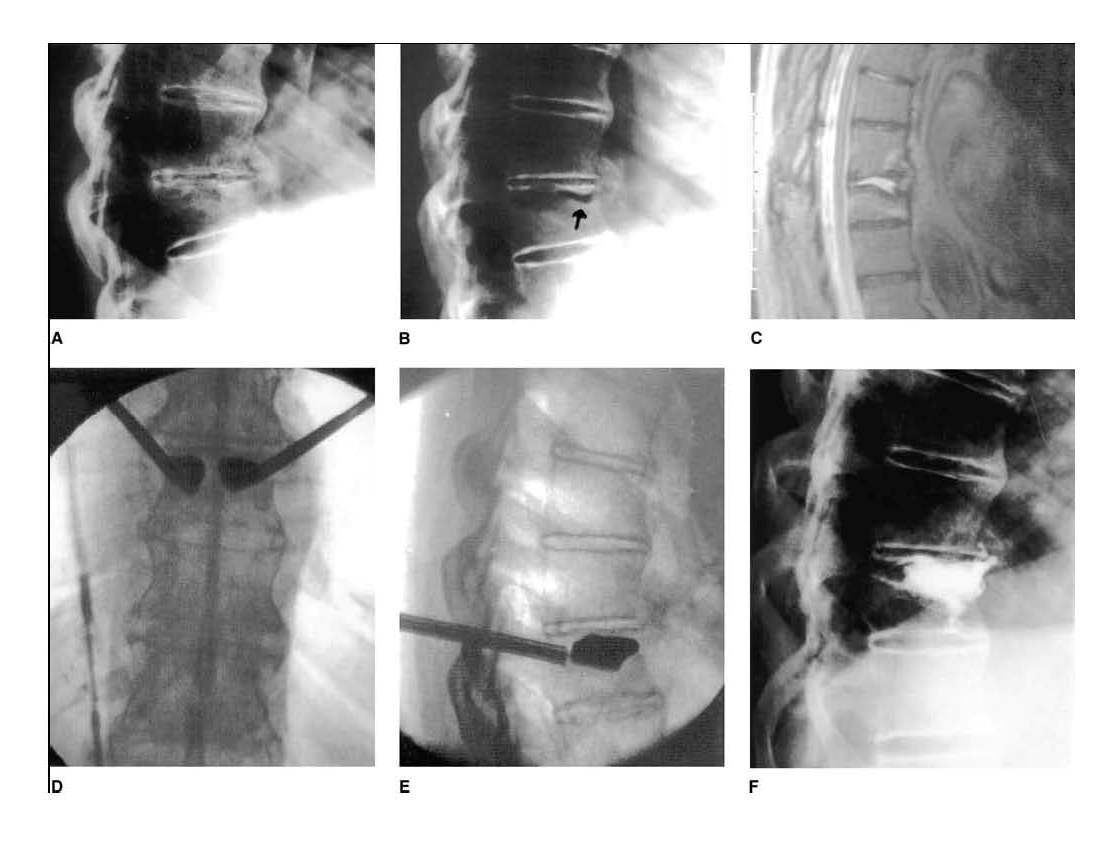
Figure 3. A 77-year-old man presented with a 4-month history of unremitting mid-back pain that limited ambulation and functional ability and required narcotic use. A: Standing lateral radiograph demonstrating an anterior compression deformity of T9. B: Supine extension lateral radiograph demonstrating an intervertebral defect (arrow) just below the superior end plate. C: T2-weighted sagittal MRI scan demonstrating the fluid-filled intervertebral cleft characteristic of a fracture nonunion. Anteroposterior (D) and lateral (E) intraoperative fluoroscopic views with bone tamps inflated. F: Postoperative lateral radiograph after stabilization using percutaneous kyphoplasty.
Nonsurgical treatment for VCFs includes bed rest, analgesics, and bracing. Limitations of this approach include the inability to restore spinal alignment and associated lack of mobility, which itself may result in an increased rate of demineralization over the duration of bed rest. In comparison, kyphoplasty has been reported to result in substantial initial symptomatic functional improvement (90%) and restoration of the anterior, middle and posterior vertebral body height when performed within three months of the onset of the fracture.
A Phase I efficacy trial of 70 consecutive kyphoplasty levels in 30 patients using SF-36 showed significant (p < 01) improvement in bodily pain, physical function, vitality, mental health, and social functioning at a mean follow-up of 6.7 months. Only general health and emotional scores did not show significant improvement. Seventy-percent of total levels showed average height restoration of 47%. Two-year follow-up of a single-center consecutive case series reported improvement in pain and function with normalization of morphologic shape indexes that remained stable during follow-up. This may be the longest follow-up reported to date.10
Complications appear to be relatively infrequent.5,11-15 Cement extravasation as well as rib fractures have been reported.10 One case of pulmonary edema and myocardial infarction was attributed to fluid overload. Other reported complications include transient fever, hypoxia and postoperative epidural hematoma (associated with a heparin bolus postoperatively). Garfin et al reported two cases of neurologic injury secondary to problems with needle insertion and positioning of the cement filling tube causing epidural cement extravasation. Intraoperative balloon rupture occurred 14 times, mostly at the end of inflation. All broken bone tamps were easily removed. No direct patient complication occurred due to balloon failure.
An important theoretical concern after the procedure is the possibility of increased force on the vertebra adjacent to a cement-injected level, with an increase in adjacent segment fracture rate. A new fracture rate of 19% has been reported (22/115) patients. Seven of the 22 patients had new fractures adjacent to injected levels.16 Although the natural history has yet to be conclusively established, a new fracture rate has been reported at 6.6% in the first year after diagnosis of one VCF and 19.2 % within the next year.17
Caution must be exercised regarding interpretation of the published reports, especially considering the level of evidence required to accept a new treatment as having a positive treatment effect. Methodologically, the kyphoplasty evidence consists of case series; a randomized trial has yet to report. A reported positive treatment effect in a case series is considered weak evidence overall.18 As kyphoplasty publications are non-comparative, they should be considered as hypothesis-generating as opposed to hypothesis-confirming, and one cannot advocate kyphoplasty as superior treatment over vertebroplasty or indeed over nonsurgical methods. In fact, a comparative trial of calcitonin in the treatment of painful VCFs demonstrates a convincing benefit over placebo, reducing pain and shortening time to mobilization.19
Given the available evidence, it is reasonable to surmise that kyphoplasty is a safe procedure with infrequently reported complications, enabling the low-pressure injection of a hardening material into vertebral bodies that have sustained a VCF, and that the inflation of the balloon is more effective at restoring vertebral endplate alignment after VCFs than vertebroplasty. The clinical significance of this local restoration of end-plate alignment and the resultant effect on overall sagittal balance is unclear, given the absence of comparative reports between kyphoplasty and vertebroplasty. In addition, the comparative effectiveness of kyphoplasty relative to nonsurgical management or the natural history of VCFs has also not been convincingly established. The lack of clarity for the role of kyphoplasty in VCFs may assume more significance when one considers the cost factor which has not been reported.
Reprinted with permission from the February/March 2006 issue of COA Bulletin
References
- Melton LJ, 1997. “Epidemiology of spinal osteoporosis.”Spine (Phila Pa 1976) 22(24 Suppl):2S-11S
- Mathis JM, Petri M, Naff N, 1998. “Percutaneous vertebroplasty treatment of steroid-induced osteoporotic compression fractures.”Arthritis Rheum 41(1):171-5
- Jensen GF, Christiansen C, Boesen J, Hegedüs V, Transbøl I, 1982. “Epidemiology of postmenopausal spinal and long bone fractures. A unifying approach to postmenopausal osteoporosis.”Clin Orthop Relat Res (166):75-81
- Melton LJ, Kan SH, Frye MA, Wahner HW, O’Fallon WM, Riggs BL, 1989. “Epidemiology of vertebral fractures in women.”Am J Epidemiol 129(5):1000-11
- Galibert P, Deramond H, Rosat P, Le Gars D, 1987. “Preliminary note on the treatment of vertebral angioma by percutaneous acrylic vertebroplasty.” Neurochirurgie 33(2):166-8
- Spivak JM, Johnson MG, 2005 Jan-Feb. “Percutaneous treatment of vertebral body pathology.”J Am Acad Orthop Surg 13(1):6-17
- Heaney RP, 1992. “The natural history of vertebral osteoporosis. Is low bone mass an epiphenomenon?”Bone 13(Suppl 2):S23-6
- Garfin SR, Yuan HA, Reiley MA, 2001. “New technologies in spine: kyphoplasty and vertebroplasty for the treatment of painful osteoporotic compression fractures.”Spine (Phila Pa 1976) 26(14):1511-5
- Lieberman IH, Dudeney S, Reinhardt MK, Bell G, 2001. “Initial outcome and efficacy of “kyphoplasty” in the treatment of painful osteoporotic vertebral compression fractures.”Spine (Phila Pa 1976) 26(14):1631-8
- Ledlie JT, Renfro MB, 2006. “Kyphoplasty treatment of vertebral fractures: 2-year outcomes show sustained benefits.” Spine (Phila Pa 1976) 31(1):57-64
- Cotten A, Dewatre F, Cortet B, et al, 1996. “Percutaneous vertebroplasty for osteolytic metastases and myeloma: effects of the percentage of lesion filling and the leakage of methyl methacrylate at clinical follow-up.” Radiology 200(2):525-30
- Weill A, Chiras J, Simon JM, Rose M, Sola-Martinez T, Enkaoua E, 1996. “Spinal metastases: indications for and results of percutaneous injection of acrylic surgical cement.” Radiology 199(1):241-7
- Gangi A, Kastler BA, Dietemann JL, 1994. “Percutaneous vertebroplasty guided by a combination of CT and fluoroscopy.” AJNR Am J Neuroradiol 15(1):83-6
- Kaemmerlen P, Thiesse P, Bouvard H, Biron P, Mornex F, Jonas P, 1989. “Percutaneous vertebroplasty in the treatment of metastases. Technic and results.” J Radiol 70(10):557-62
- Moreland DB, Landi MK, Grand W, 2001 Jan-Feb. “Vertebroplasty: techniques to avoid complications.” Spine J 1(1):66-71
- 2002 Sep-Oct. “Abstracts of the North American Spine Society 17th Annual Meeting. Montreal, Canada, October 29-November 2, 2002.” Spine J 2(5 Suppl):45S-133S
- Lindsay R, Silverman SL, Cooper C, et al. 2001. “Risk of new vertebral fracture in the year following a fracture.” JAMA 285(3):320-3
- Lyles KW, 1999. “Management of patients with vertebral compression fractures.” Pharmacotherapy 19(1 Pt 2):21S-24S
- Ringe JD, Orwoll E, Daifotis A, Lombardi A, 2002. “Treatment of male osteoporosis: recent advances with alendronate.”Osteoporos Int 13(3):195-9
Attachments:

Kyphoplasty_Figure_1.jpg (image/jpeg)
Kyphoplasty_Figure_2.jpg (image/jpeg)
Kyphoplasty_Figure_3.jpg (image/jpeg)