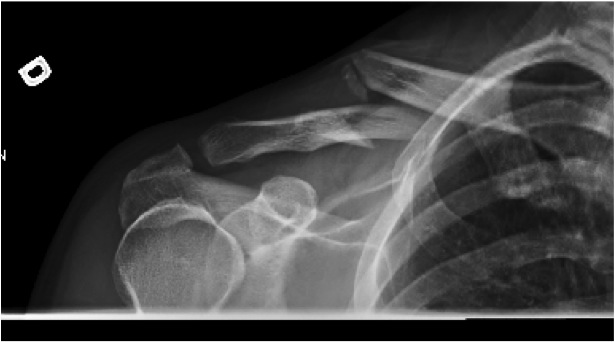
Clavicle Fracture – Plate Fixation for All
Clavicle fractures are recognized as being among the “best fractures” to have in the upper limb, since most heal well without complication. Over the last few decades, conservative treatment, or “careful” neglect, was the standard of care. Closed reduction was considered wishful thinking; thus fracture displacement was accepted.
However, our comprehension of the management of clavicle fractures has evolved as a result of recent studies.
 Read more…
Nowac et al conducted a prospective study of 208 cases of clavicle fractures and showed that 46% presented with a functional deficit at the 10-year follow-up.11 McKee et al also found a significant functional impairment when clavicle fractures were treated conservatively. Moreover, Kulshrestha et al reported 29% nonunion and 36% malunion following conservative treatment of displaced clavicle fractures at 18 months.
In the face of these striking data, standard conservative treatment of clavicle fractures has been put in doubt. We must now ask: 1) Can we obtain better results with surgery? 2) Are the surgical risks worth it? Our answer is YES for a large percentage of patients.
Advantages of Surgery
Two Level 1 articles have illustrated the advantages of surgery over conservative treatment. The study done by the Canadian Orthopedic Trauma Society (COTS) demonstrated improved function, according to the Constant score and DASH score, at 1-year follow-up in the plate group when compared to the conservative treatment group for displaced middle third clavicle fractures. One third of the conservatively treated patients developed significant malunion (18%) or nonunion (15%).
Furthermore, a smaller randomized study of 60 patients by Mirzatolooei et al reported similar results in terms of improved outcome with surgery.10 Several other studies have also demonstrated better functional outcomes in the surgical group, when evaluating the differences between nailing and conservative treatment.7,14,15
Risks of Surgery
In the COTS study, 5% of the patients in the surgical group had wound healing problems and 8% required plate removal. The Mirzatolooei study obtained a similar 4% infection rate (1/26).10 The risk of nonunion following surgery was respectively 1/61 (2%) and 4% in both Level 1 studies.
Who to Fix
The following question must be asked: Who should we fix? The literature offers us guidelines in order to identify patients at risk of nonunion and lower functional outcome.1,5,11,13 These risk factors for poorer results with conservative treatment can be used to guide surgeon-patient discussions.
|
Factors Orienting Toward Fracture Fixation |
|---|
|
How to Fix?
When the decision is made to operate, how should we fix the clavicle?. Clinical studies comparing nail versus plate fixation have not shown any difference between the implants; however, the studies were either underpowered or using retrospective design. Nail migration and clavicle telescoping in cases of fracture comminution have been reported in the literature.14, 15 With complex fractures, biomechanical studies have demonstrated better results with plate fixation and locking.3,12
Conclusion
Plate fixation is recommended for displaced clavicle fractures in healthy adult patients in order to obtain improved functional outcomes and better patient satisfaction at mid-term follow-up, enhanced healing rates, as well as a better restoration of the anatomy. However, patients must be aware of the potential risks associated with surgery, such as infection (5%) and plate removal (8%).
Reprinted with permission from the Fall 2011 issue of COA Bulletin
References
- Bravo C.J., Wright C.A. Displaced, comminuted diaphyseal clavicle fracture. J Hand Surg Am. 2009 Dec;34(10):1883-5. Review. PubMed PMID: 19969194.
- Canadian Orthopaedic Trauma Society. Nonoperative treatment compared with plate fixation of displaced midshaft clavicular fractures. A multicenter, randomized clinical trial. J Bone Joint Surg Am. 2007 Jan;89(1):1-10. PubMed PMID: 17200303.
- Celestre P., Roberston C., Mahar A., Oka R., Meunier M., Schwartz A. Biomechanical evaluation of clavicle fracture plating techniques: does a locking plate provide improved stability? J Orthop Trauma. 2008 Apr;22(4):241-7. PubMed PMID: 18404033.
- Ferran N.A., Hodgson P., Vannet N., Williams R., Evans R.O. Locked intramedullary fixation vs plating for displaced and shortened mid-shaft clavicle fractures: a randomized clinical trial. J Shoulder Elbow Surg. 2010 Sep;19(6):783-9. PubMed PMID: 20713274.
- Hillen R.J., Burger B.J., Pöll R.G., de Gast A., Robinson C.M. Malunion after midshaft clavicle fractures in adults. Acta Orthop. 2010 Jun;81(3):273-9. Review. PubMed PMID: 20367423; PubMed Central PMCID: PMC2876826.
- Kulshrestha V., Roy T., Audige L. Operative versus nonoperative management of displaced midshaft clavicle fractures: a prospective cohort study. J Orthop Trauma. 2011 Jan;25(1):31-8. PubMed PMID: 21164305.
- Lee Y.S., Lin C.C., Huang C.R., Chen C.N., Liao W.Y. Operative treatment of midclavicular fractures in 62 elderly patients: knowles pin versus plate. Orthopedics. 2007 Nov;30(11):959-64. PubMed PMID: 18019991.
- Liu H.H., Chang C.H., Chia W.T., Chen C.H., Tarng Y.W., Wong C.Y. Comparison of plates versus intramedullary nails for fixation of displaced midshaft clavicular fractures. J Trauma. 2010 Dec;69(6):E82-7. PubMed PMID: 20664374.
- McKee M.D., Pedersen E.M., Jones C., Stephen D.J., Kreder H.J., Schemitsch E.H., Wild L.M., Potter J. Deficits following nonoperative treatment of displaced midshaft clavicular fractures. J Bone Joint Surg Am. 2006 Jan;88(1):35-40. PubMed PMID:16391247.
- Mirzatolooei F. Comparison between operative and nonoperative treatment methods in the management of comminuted fractures of the clavicle. Acta Orthop Traumatol Turc. 2011;45(1):34-40. doi: 10.3944/AOTT.2011.2431. PubMed PMID: 21478660.
- Nowak J., Holgersson M., Larsson S. Can we predict long-term sequelae after fractures of the clavicle based on initial findings?A prospective study with nine to ten years of follow-up. J Shoulder Elbow Surg. 2004 Sep-Oct;13(5):479-86. PubMed PMID: 15383801.
- Renfree T., Conrad B., Wright T. Biomechanical comparison of contemporary clavicle fixation devices. J Hand Surg Am. 2010 Apr;35(4):639-44. PubMed PMID: 20138445.
- Robinson C.M., Court-Brown C.M., McQueen M.M., Wakefield A.E. Estimating the risk of nonunion following nonoperative treatment of a clavicular fracture. J Bone Joint Surg Am. 2004 Jul;86-A(7):1359-65. PubMed PMID: 15252081.
- Smekal V., Irenberger A., Attal R.E., Oberladstaetter J., Krappinger D., Kralinger F. Elastic stable intramedullary nailing is best for mid-shaft clavicular fractures without comminution: results in 60 patients. Injury. 2011 Apr;42(4):324-9. Epub 2010 Apr 14. PubMed PMID: 20394920.
- Smekal V., Irenberger A., Struve P., Wambacher M., Krappinger D., Kralinger F.S. Elastic stable intramedullary nailing versus nonoperative treatment of displaced midshaft clavicular fractures-a randomized, controlled, clinical trial. J Orthop Trauma. 2009 Feb;23(2):106-12. PubMed PMID: 19169102.